Exit 8 Big Top Mall and Video Arcade
The One and Only IvanExit 8 Big Top Mall and Video Arcade is both a shopping and entertainment complex and the place where Ivan spends his years in captivity. Located off Interstate 95, it combines arcade lights, mall businesses, scheduled animal shows, and enclosed animal domains. The contrast between its invitations to human visitors and the fixed boundaries of Ivan’s world makes the mall more than a backdrop: its arrangement determines who can move freely, who watches, and who is watched.
Setting and Commercial Design
The mall advertises itself as a convenient stop beside Interstate 95, with shows scheduled at two, four, and seven every day of the year. Its name and roadside billboard make the attraction legible to passing motorists, promising a destination built around shopping, entertainment, and the celebrated gorilla who lives there. The sign’s boastful language presents Ivan as the mall’s singular attraction, converting his identity into part of its public brand.
Inside, the environment is crowded with distractions. A carousel turns to creaky music; monkeys and parrots live among the merchants; and pinball machines flash beside pink clouds of cotton candy. At the center, a ring surrounded by benches gives visitors a place to sit with soft pretzels and watch the shows. Sawdust covers the floor, described as the remains of dead trees. The mall thus brings commercial activity, leisure, and animal display into one space, with the performance ring at its center.
Animal Domains and Glass Boundaries
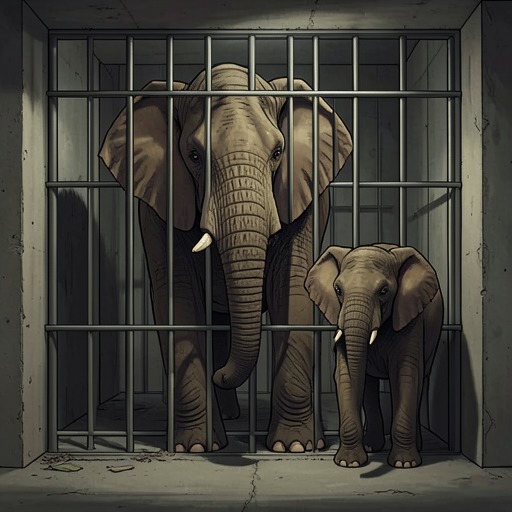
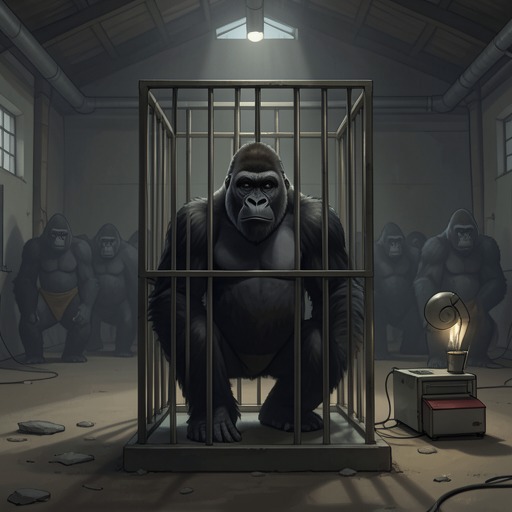
Ivan’s domain lies at one end of the ring, while Stella’s is next to his. The novel calls these spaces domains, but their position within the mall and the barriers that define them show how sharply animal life is contained. Ivan explains his separation by saying he is too much gorilla and not enough human. Although he can see across much of the building, he has no gorilla friends there; Stella and Bob, a dog, are his closest companions.
Three windowed walls give Ivan a view of the mall and a portion of the world beyond it: the arcade, cotton candy, and a broad, treeless parking lot. Beyond the lot, traffic rushes along the freeway, and a huge sign beckons drivers to stop. The windows offer sight without access. At the enclosure, visitors press their small hands against the glass, leaving fingerprints sticky with candy or slick with sweat. Each night, a tired man wipes them away. The repeated contact makes the transparent wall both a viewing surface and a reminder that proximity does not undo separation.
A Public Attraction and a Private Viewpoint
The mall’s visitors arrive amid flashing lights and pointing fingers, while Ivan experiences their attention as an unavoidable condition of his life. People can approach the glass and look in; Ivan remains on the other side, exposed to their gaze. From his enclosure he can watch the human activity around him, but the view does not give him the freedom to join it. The building’s design therefore divides the same scene into two different experiences: access and entertainment for visitors, observation and confinement for the animals.
The billboard extends this arrangement beyond the parking lot. Its colors have faded and run, but Mack once reads its message aloud, naming the mall as the home of the one and only Ivan, mighty silverback. Ivan cannot read, though he wishes he could, and imagines reading stories as a way to fill the empty hours. The sign speaks publicly for the mall, while Ivan’s wish points to an experience the advertising cannot convey: long stretches of time spent inside the enclosure.
Publicity and the Mall’s Changing Role
Later, a photograph of Ivan’s billboard appears in the newspaper, and Mack tapes the story to Ivan’s window. More curious people arrive each day, parking in front of the billboard, pointing, shaking their heads, and taking photographs. The mall’s advertising has become part of a wider public response: the image draws attention not only to the attraction but also to the conditions represented by it. The newspaper story and the visitors’ changed attention mark a shift in how the site is seen, even as the animals remain inside.
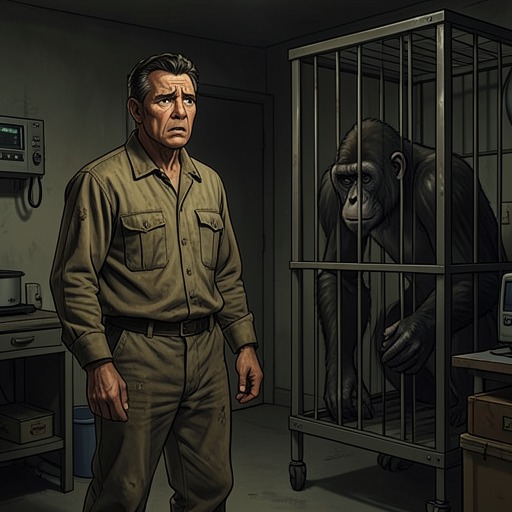
The eventual opening of Ivan’s cage door makes the mall’s physical boundaries newly visible. A giant box has been pushed against his doorway, and the open door leads directly into it. The passage out is not simply an unimpeded exit: leaving the enclosure means entering the transport box. The scene turns a familiar threshold into a decision point, revealing how movement away from the mall is itself controlled and channeled by human arrangements.
Significance
The mall’s central contradiction is built into its spaces. It offers humans an inviting sequence of shops, games, food, and scheduled shows, while placing animals inside domains where they can be seen but not freely move among the visitors. Glass makes the separation look thin; the enclosure’s organization makes it decisive. Even the nightly cleaning of fingerprints restores the surface without changing the division it marks.
The later view of a high, carefully built wall at the zoo complicates any simple equation between leaving the mall and becoming free. The wall stretches toward other habitats and is expressly built to keep the animals in and others out; Ivan recognizes that it remains a cage. In this contrast, the mall stands as the first and most commercial form of confinement in the account, while the later setting offers a different environment without erasing the limits imposed by captivity.